Your book is still a folder of notes.
Bring what you know. AI drafts each chapter, you edit and approve, and you get print and ebook files.

How it works, in four steps
You write it.Describe your reader and the points the book must make.
AI drafts. You approve.Rename, reorder or drop chapters before any chapter is drafted.
AI drafts. You edit.Read each chapter and change any line, right on the page.
You download the files.Print files, the preflight report, and every ebook file it checked.
From brief to book.
The brief
- What it argues
- One fixed hour each week spent reviewing every open commitment gives a busy person more control than any app, planner or daily system, because it is the one place every loose end is looked at on purpose.
- What it must include
- what to collect before the review starts
- how to decide what to drop rather than reschedule
- what to do in the week the review gets skipped
The book

Chapter 1: Why Daily Systems Keep Failing You
You download the app. You set up the lists. You feel, for about two weeks, like a person who finally has their life organized. Then one morning you open it and there are forty-one items in your inbox view, a dozen of them red because they're overdue, and the thing that was supposed to make you calm just made your stomach drop before you've had coffee. …
How it works


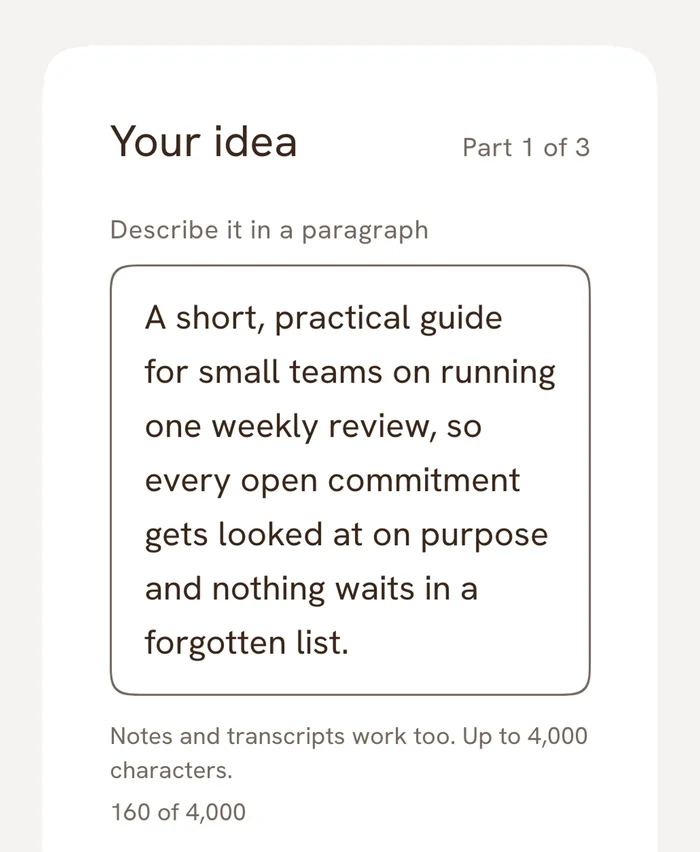
Your idea
Who it is for, and the points it must make.
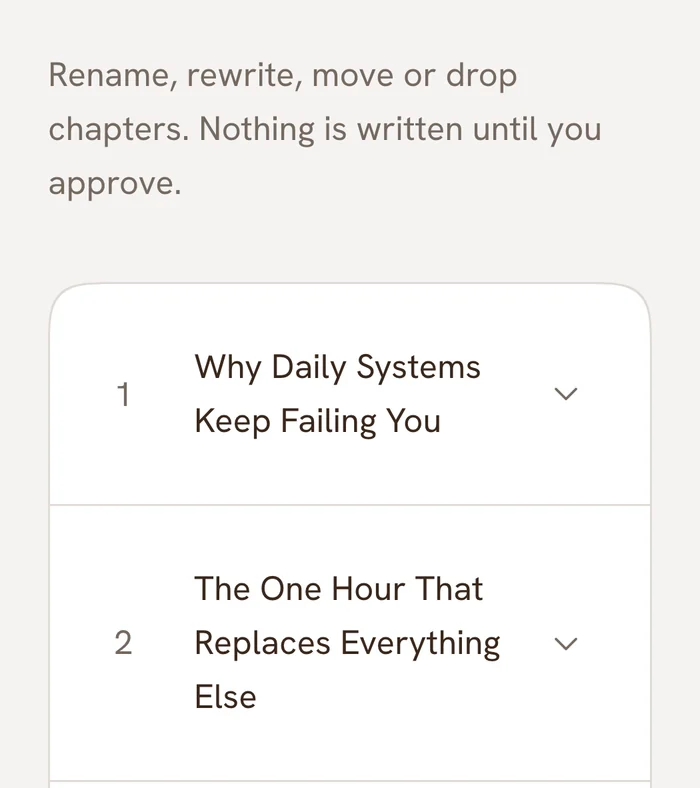
The outline
AI drafts it from your brief. No chapter is drafted until you approve.
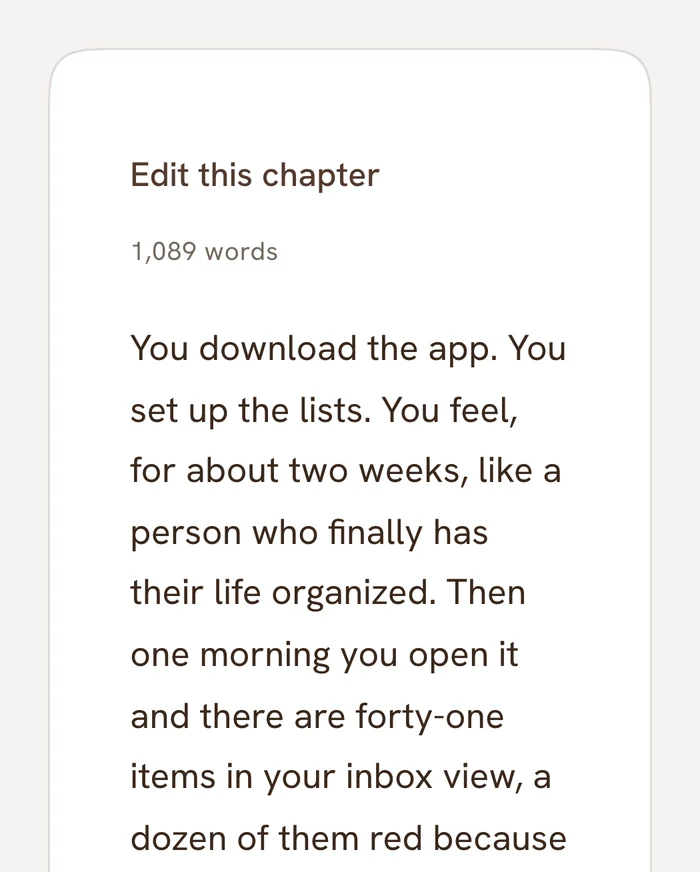
Every chapter
AI drafts each chapter. Edit any of them, then export the files.
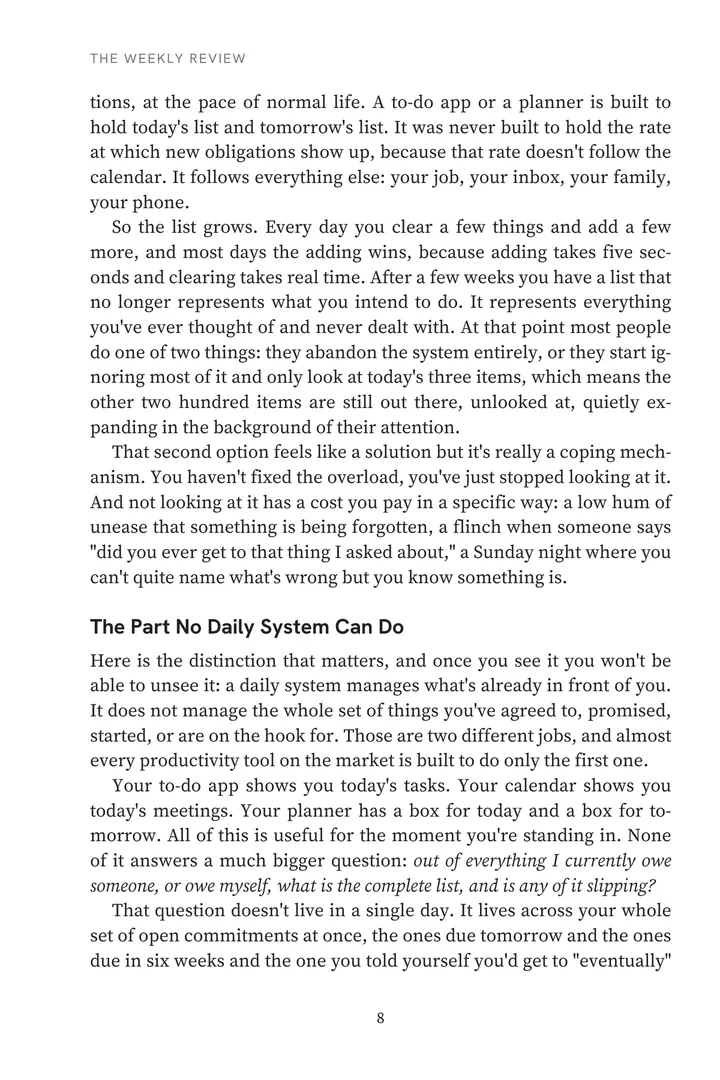
Page 8 of The Weekly Review, rendered from its interior file, with four of its measurements drawn on it. - Rule 1, trim
- 6 × 9 in
- Rule 2, inside margin
- 28.44 pt
- Rule 3, bottom margin
- 30.82 pt
- Rule 4, bleed
- 0.125 in
If you publish on KDP: the print check.
Publishing on Amazon KDP? Every page is measured against KDP’s published print specification before you upload.
You upload the files yourself. Acceptance is Amazon’s decision.
We flag facts you didn’t give us. Your book waits for your OK.
The Weekly Review, an example we wrote to show the check
People who review their commitments every week complete about 30 percent more of them than people who do not. The reason is not discipline. A weekly look makes each open item compete for a place on the page, and the items that cannot win one are the ones you were never going to do. …
What the check found
3 claims to check
While these stand, this book does not export.
Our writer stated these as facts, and nothing in your brief backs them.
A figure
“People who review their commitments every week complete about 30 percent more of them than people who do not.”
2 more claims in this chapter
You bring the part only you have.
Three short parts. No chapter is drafted before you approve the outline.
Your idea
Pasted notes, up to 4,000 characters, and the kind of book.
How it reads
Your reader, a few questions, and the length.
What it covers
A title, your argument, your reader and one to 20 points. Nothing is drafted without them.
The kinds of book it drafts.
How to
A method, taught in order.
Guide
A subject, mapped for newcomers.
Self help
A change, with its argument and steps.
Business
A way of working, for professionals.
Reference
Made to be looked up.
Workbook
Explanations with exercises to complete.
Something else
Planned from your idea and points.
Why not just use an AI chat?
Files for a paperback you can hold. An ebook you can send.

Before a word is drafted
- It starts from your brief
- Your argument, your reader and what it must include.
- You approve the outline
- No chapter is drafted until you do.
- The length you chose
- Each drafted chapter is checked against it.
While it drafts
- Continuity checked across chapters
- A report names each contradiction it finds, for you to settle.
- Stories checked against your brief
- It must list each fact and story. One marked unsupported stops export until you cut or confirm it.
- Every chapter checked
- An em dash or a banned phrase stops export until fixed.
In the export pack
The Weekly Review
- Print interior
- 6 × 9 in, 48 pages
- Print PDF, every page measured.
- Wrap cover
- 8.64 pt spine
- Spine sized from the page count.
- Ebook editions
- EPUB, Word, PDF
- Each with its own checks.
If you publish on KDP
- The KDP print check
- KDP’s print rules and our own, each measured.
- Listing metadata
- Description, keywords and categories, drafted to edit.
- AI disclosure answers
- KDP’s questions, answered from each section’s record.

What we show you, on our own sample.
The Weekly Review’s own report, from its export pack.
Checked for KDP
Against KDP’s published print rules and our own. 14 of 14 rules passed. 20 of 20 further checks passed.
- Trim size
- 6 × 9 inAll 48 pages
- Passed
- Inside margin
- 28.44 pt27.00 pt required
- Passed
- Spine
- 8.64 ptFor 48 pages
- Passed
- PDF/X-1a
- 46 of 46Rule 12 checklist items
- Passed
- Claims checklist
- No flagged unsupported claim in 10 of 10 chapters.
- AI disclosure
- Recorded for 10 of 10 sections.
You upload to KDP yourself. Acceptance is Amazon’s decision. An edit makes the report stale, and export runs it again.
Our sample books
One of our samples
The 5 to 9
Building a Side Project Around a Full-Time Job
Choose how you pay
You pay on Polar’s checkout. Card details never reach us.
Prices in USD. In the US, Canada and India, tax is added at checkout; elsewhere, any tax is included in the price.
Paid once
$19 a book
Or 3 books for $39, $13 a book. Paid once, with nothing to cancel. Credits never expire, and are refunded if we ever close.
For one book, or a few over time.
One finished book, print and ebook, up to 30,000 words.
Studio, monthly
Recommended for a series$39 a month
Renews monthly until you cancel. Cancel any time from your billing page; you keep the month you paid for.
For a series: 3 new credits every month, $13 a book if you use them all. For one book, Paid once costs less.
3 credits a month, one book each, up to 30,000 words. Unused credits roll over, up to 3.
Frequently asked questions
Who writes the book?
You bring the idea, your reader and what it must say. AI drafts the outline and every chapter. You edit and approve.
Will the AI make things up?
It can. It must list every figure, date, quote, name and story. One it marks unsupported stops export until you cut or confirm it. It can miss or mislabel one, so read every chapter.
Will it sound like me?
It follows the tone you describe. It does not learn from your past writing.
What does a book cost, and can I get a refund?
One credit buys one finished book of up to 30,000 words. The prices are in the pricing section above. Unused credits are refundable for 14 days from the purchase. Our policy does not refund a credit a book has used. It does not limit your rights in law.
Do you put the book on Amazon?
No. There is no public KDP publishing interface. You upload the files yourself, and acceptance is Amazon’s decision.
Who owns the book?
You own what you bring. We claim no rights in the book. The law on AI-drafted text is still unsettled.
Is this a book mill?
No. One book at a time per account. No batch generation. Every book starts from your own brief. Every flagged claim must be cut or confirmed by you before export.
What books can’t I make?
No books that give medical treatment or investment advice. Fitness, healthy habits and everyday money skills are fine. Our terms list the few other things we don’t make.