We show the measurements. Every print claim points at a row.
Publishing tools describe their output as ready for Amazon KDP. The difference here is an artefact you can read: a report run against the finished files, printing what was measured beside what the rule asked for, and naming whose rule it is. Every claim we make about print readiness points at one of its rows.
The artefact
The report is run against the finished files
Nothing on the report is an intention. Each check opens the rendered interior and cover PDFs, measures one thing, and records the value it found beside the value the rule asks for. The report is shown in the app beside the files it measured, before you download any of them, and the export pack carries a copy of it out alongside the files it describes.
Every report is stamped with the revision of our KDP specification table it was checked against, and it keeps that stamp for as long as the report exists. The stamp is what stops the proof quietly decaying into an assertion when Amazon changes a number.
The capture is shown at full size. Scroll it sideways to read the whole row.
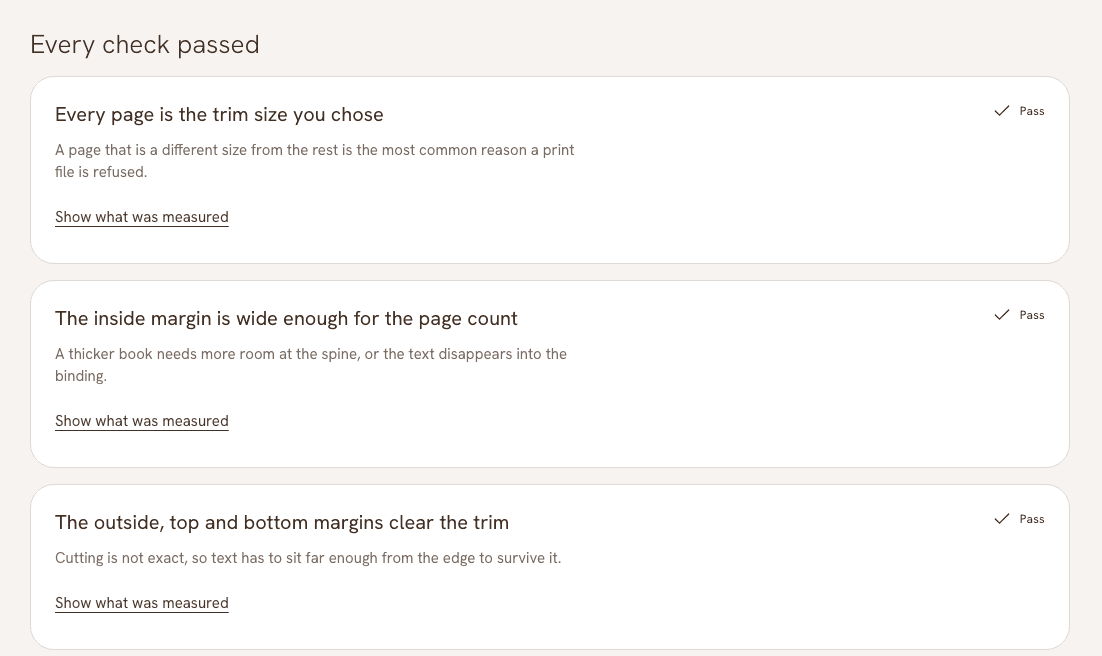
One row
What a single row shows
A row names the check in plain language, says why it matters for a printed book, and opens to show four things: the value measured in your file, the value the rule requires, what exactly was checked, and whose rule it is with the specification rows behind it.
The capture is shown at full size. Scroll it sideways to read the whole row.
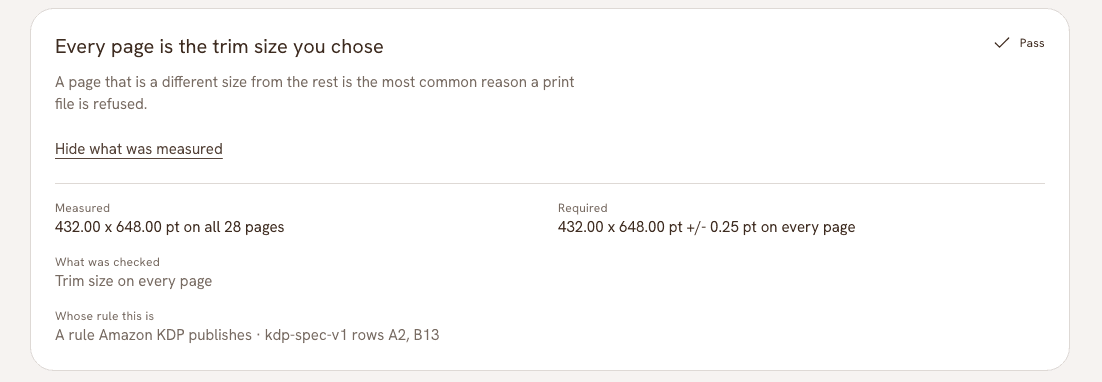
A check that did not pass is shown first, opened, with its measurement already visible. The thing that tells you what to change is not hidden behind a click.
Whose rule
Whose rule each check enforces
Not every check is Amazon’s. Some are their published requirements, some are things they recommend, and some are ours because the published number is not enough to survive a real press. Blurring those together would be the easiest way to overstate what we prove, so every row carries one of exactly three labels.
- A rule Amazon KDP publishes
- Amazon states this requirement in its own specification. The row cites the table rows it came from.Recorded internally as KDP conformance.
- Something Amazon recommends rather than requires
- Amazon advises it rather than requiring it. A file that misses it can still be accepted; the report does not predict what Amazon will decide either way.Recorded internally as an Amazon recommendation.
- Our own rule, stricter than the published one
- A tighter bar than the published number, each one with a recorded reason. Spine text is the clearest: Amazon permits it above 79 pages, and we set it only where seven point type plus the clearance actually fits, so a book between 80 and 88 pages carries none and the row says why.Recorded internally as a Trimline rule, after this project’s internal codename.
The limits
What the report does not claim
This is the part most pages leave out, so it is written in full.
- It is not Amazon's decision
- The report measures your file against a specification. Acceptance is Amazon's, made by their own review against policies they can change. A passing report is evidence, not an outcome. See the refunds page for how we handle a rejection after a pass.
- We do not upload for you
- There is no public KDP or Apple Books publishing interface for us to integrate with, so InkReady does not put your book on sale. You upload the files we hand you.
- It measures the files, not the writing
- The checks cover the interior and cover PDFs: their geometry, colour, fonts, embedded resources and the render records behind them. The quality of the prose is scored separately, against our own rubric, and that score is shown as what it is: provisional, and no substitute for reading your book.
- It measures the files it was given
- A report belongs to one render of one book. Edit the book and the report no longer describes what you have.
- It says nothing about anybody else
- We have not inspected a competitor's output, so we make no claim about it. What we say is what we measured in your file.
Going stale
An edit invalidates the report
Changing a chapter can change the page count, and the page count decides the gutter, the spine width and whether spine text is allowed at all. So any edit that can move the page count marks the report as no longer describing your files, and the page says so rather than showing you a stale pass.
Exporting runs the checks again on the files it is about to freeze. Every file in the pack is then read back out of storage and hashed a second time, and the download is refused rather than served if any of them is not the file the report measured. A pack you have already taken keeps describing the book as it was on the day it was frozen, and says so.
Fonts
The type in your book, and why you can sell it
Your interior is set in Source Serif 4 by Adobe, and the running heads, the cover and this site are set in Hanken Grotesk by Alfredo Marco Pradil. Both are released under the SIL Open Font License 1.1, which permits embedding them in a document you sell. That is the whole point of naming them here: a font licence that did not allow commercial embedding would make every file we hand you unsellable, and you would have no way of knowing.
You owe nobody a credit inside your own book. We checked each licence against the foundry’s own text before shipping, and any face we add later gets the same check first.
If a check on your report looks wrong, that is worth an email: support@inkreadyai.com, with the report id. A rule of ours being wrong is a thing we would rather find than defend. See also privacy and refunds and credits.